Author: Theur

  • Trump’s attempted assassination and America’s murky political atmosphere 

    Trump’s would-be assassinator really did us a service. The already charged political atmosphere in America has now heated up not least due to the conspiracy theories spun out of the Republican mill. Those on the leftist bandwagon on the other hand have gone so far as to claim that it’s been staged, “not a real bullet, you see; a silly pellet”, “the blood should have splattered across his face, just a streak, not convincing” . While factions are getting factionalised further in what is now a routine theatrical campaign mode for Americans there are comparisons with Trump’s apparent heroism in hitting the fist pump amid the chaos as the secret service scrambled to protect him, his ears bleeding, and Biden’s mental and physical fragility, a fact exemplified by his struggle to put together a coherent phrase and climb two stairs. The picture that was clicked by an AFP photographer which has Trump doing the fist pump with the American flag flying in the background is likely to galvanise his support base, and possibly draw in the neutrals. It sets a terrific scene. And gives us a insider perspective into what Hillary Clinton has claimed is his “animal instinct” — the ability to sense every twitch of nerve, understand the weaknesses of the opponent, put himself in the limelight, and real good street-style common sense. His words as the fist was raised were “fight, fight, fight”. Setting aside the perceptible gallantry of the phrase, what’s exactly is this “fight” against? It’s interesting given that it is Trump and his acolytes that had endorsed the apparently “patriotic” rioters to storm the capitol hill. In the last day’s assassination attempt which is unfortunate and troubling for the US, Trump has managed to turn the narrative around him. He is posturing as the one fighting against the establishment.  Even when the bullet pierced his ear, a part of him was sure that he was not going to let go of this opportunity, an opportunity like no other. He has captured the moment.

    On the other side of the political divide we have the frail Biden who can’t speak sensibly for ten minutes straight. The Democratic establishment that has been protecting him for weeks with cover-up and lies stands exposed. From calling Kamala Harris “Vice President Trump” to addressing Ukraine President Zelensky as “President Putin” (even worse) there’s no reason to think that this octogenarian will be capable of leading the government. The septuagenarian Trump may look like a shabby old man, but his will supersedes his physical deficiencies. And he strongly believes that he can beat sleepy-Joe. 

    While Trump’s assassinator may have done ironically done us a service by spiking the political atmosphere, hard-line republicans can’t belt up. Blame has been heaped on the Government for not adequately providing him with security cover. While this claim can be disputed, there are serious concerns about the functioning of the security service in the country. Multiple assassinations against sitting presidents have been attempted in the past — worse, when Obama was the President a shot into the White House went unheeded for four days dismissing it as noise from a nearby construction project, until a house keeper pointed out a broken window. The service has been riled with corruption and ineptitude. This is concerning in a country where arms are wielded freely, so much that we have reached a stage where a twenty-year old can ponder about shooting down a former president running for election. Gun violence is at a historic high and several firing incidents are reported every week. 

    What might have prompted Thomas Crooks’ to carry a rifle to the Pennsylvania rally? What might have persuaded a high-school graduate to turn into a sniper on that odd day? The case makes for an interesting investigation as the boy has been found to be a locally registered member of the Republican party. He is described as being bright at “math” and a “conservative” by his former school-mates. What the truth holds for this odd tale of attempted political murder and for the country as a whole and the tumultuous time it’s been going through remains to be seen. A few things are certain: the killer undertook a dangerous path in his pursuit for killing a popular, polarising figure, succumbing to a counter-fire in the immediate aftermath, and a precious life was lost, that of an unassuming rally-goer who may have never imagined this fate when he stepped out of his house. Trump had been scoring more in poll-ratings after the depressing debate and during the days in the run up to the assassination. Now his re-election, the prospect of a dangerous Trump 2.0 at the White House, on November 5th looks increasingly probable. 

  • Rushdie, ‘Haroun’ and ‘the Sea of Stories’

    Rushdie, ‘Haroun’ and ‘the Sea of Stories’

    ‘Haroun and the Sea of Stories’ is a fantastical tale — a tale we wish to revel in, the tale we wish, someday, would be our own. On the way we meet a storyteller Rashid who can spurn stores out of thin air, his wife who has a beautiful voice, and his only son Haroun. Rashid is renowned for his ability to transpose people to another realm through his invective tales. Politicians often hire him to woo voters because of his ability to keep people hooked through his marvellous storytelling. It is said none but he alone can have such a grasp over listeners’ attention. But one day all goes awry as Rashid’s wife leaves him for an unpleasant neighbour who keeps asking a question that seems to have struck a chord with Rashid’s wife, “what is the point of stories that aren’t even true?”. Soon afterwards, Rashid finds himself bereaved of that magical superpower that had rendered him invulnerable for long – the power to create stories. Haroun is devastated and Rashid becomes literally speechless. Every time Rashid attempts to narrate a story to the crowd all that comes out is a croak, much to his embarrassment and disappointment. Moreover Rashid and Co., live in a ‘sad’ city, “a city so ruinously sad that it has forgotten its name.”  

    Wherefrom does Rashid’s magic to create stories out of nowhere emanate? The sea of stories. But Rashid’s downturn of sorts is speculated to be the result of a despotic tyrant in the ‘Land of Chup (Silence)’ Khattam-Shud who wants the sea of stories to be poisoned (quite a devilish bloke!). As the name suggests, the inhabitants of the Land of Chup glorify silence and darkness; just a streak of light would blind them. 

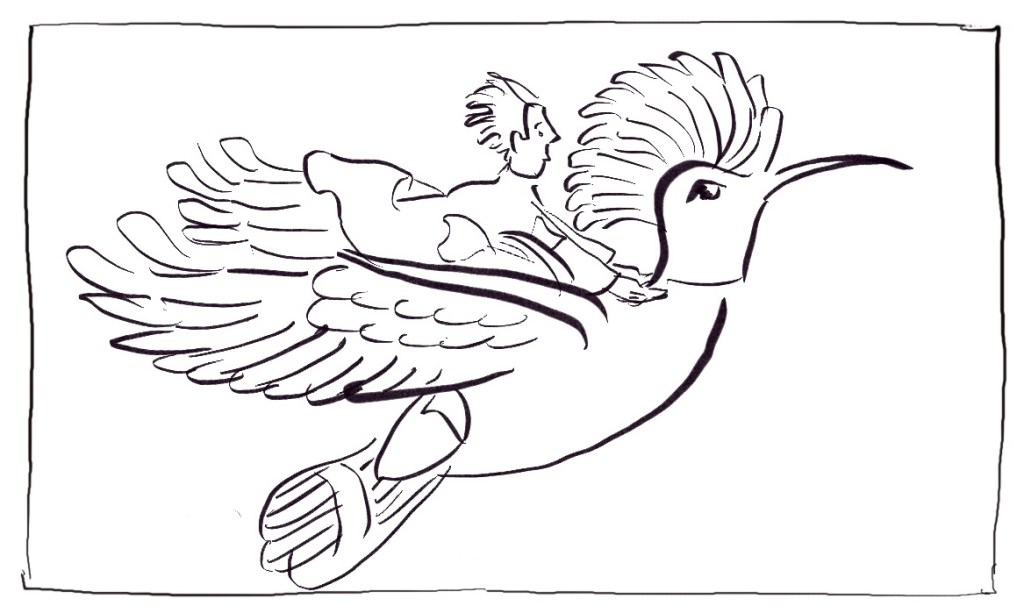
    The story takes may turns hereupon; leapfrogging our way through, we find Haroun and his father at a politician’s chuckhole. During the night, when everybody’s sleeping, Haroun encounters the water genie who is responsible for the story tap through which tales metaphorically gush out enabling Rashid to tell stories. Haroun wants to cure his father’s ailment, and so he embarks on an adventure with the water genie. On the way, he meets a magical bird ‘Hoopoe’, ‘Plentimaw fishes’ and many wholesome characters. Towards the close of the mysterious journey they end up at a kingdom. To his surprise Haroun meets his father there. Fables of wisdom, betrayal, friendship, and the usual feuds, yarn along the corridors of the kingdom. In the end, Haroun manages to finish off ‘Khattam-Shud’ whose name means “completely finished” (as it ought to be). Rashid regains his voice and power of making stories. The father and the son return home, and the city in which they’ve been dwelling secures a fitting name for itself, ‘Kahani’. Miraculously, Rashid’s long-lost wife is home too.

    Haroun is perhaps one of us. Just as the son of the story-teller Rashid — who finds more pleasure in pumping blahs into the ears of unsuspecting denizens than staring at his wife throughout the day — the reader too is transposed into a realm of limitless imagination. From birds that can read your mind, to princesses that sing with their unpleasant voices, ‘Haroun and the Sea of Stories’ is a complete fantasy, and a humorous one at that. 

    Rashid has indescribable powers for conjuring up stories out of thin air.  In a land of unforgiving agony, it is stories that enliven the spirit of the townsfolk. But one day everything goes topsy-turvy. Salman Rushdie manages to transpose the gloom that impregnates the situation into one of enervating joy with an Arabian Nights-esque candour giving the reader plenty to revel in. The brilliance of Rushdie is marked by his ability to pull off this feat — of mixing a formidable threesome: magic, humour, adventure — a feat so incredible few in the literary world would be able, and willing, to emulate. To Rushdie the master storyteller here’s a fellow Haroun’s love. 

  • Ireland : 100 years of ups and downs

    More than a century ago, Ireland broke apart. To the south, were the Catholics who wanted to become independent and on the north (or north-east), were the Protestants who wanted to stay with the United Kingdom. But the blighted unease of the Southerners with the inhabitants to the north-east of the little island date back to centuries. Perhaps, one could blame the British, for failing to grant the will of the people, as they’ve always done in colonies around the world. The British being British after all. 

    The Easter Rising in 1916 spelled doom for the largely Protestant British rulers who had been fighting a costly World War I. It was the second major rebellion by the Irish republicans who sought an independent Ireland. Granted their wishes, did the British, but by carving out a free state for the Catholics in the South, which was hardly a solution to their concerns. The Irish War of Independence, fought in 1919 by the Irish Republican Army (IRA), led to the signing of the Anglo-Irish Treaty in 1921. During that year, a border was drawn, rending Ireland into two portions, ensuring that the Protestant dominant regions remained at the North and the rest at the South. This explains the unusually jagged border of Ireland that forever changed the politics of the UK.

    In the process, one community suffered, the disgruntled minority Catholics in the north. To defend themselves, the Catholics took the aid of the old Irish Republican Army (IRA) and waged an armed struggle against the British.  Fast-forward, three decades later, the ‘Troubles’ began, notorious for the vile heroics of the Irish Republican Army, deaths, and much suffering. 3500 deaths, 400 of which came during the 90s. And the latter, when security and intelligence services had been at flying at a reasonably advanced state. But at the end of it all, with much wresting and persuasion, a remarkable agreement was struck — the Belfast (or the Good Friday) agreement in 1998. It is an archetypal deal, with concessions and powers apportioned to each side considerably. Governance of the region was marked by a power-sharing agreement. Consensus of both, unionists and nationalists are required for key bills to pass. A referendum is to be conducted if a majority of the region’s inhabitants wishes independence and union with the Republic of Ireland. No room for the majority Protestants faff about, and thump the rest under their feet and at the same time enough safeguards assuring the Catholic minority. 

    For three decades the Troubles had wreaked havoc in their lives. Neither cause – that of the IRA nor the Unionists seemed justifiable. In quiet relief, with the forging of an impossible agreement, the people of Ireland safely retreated indoors paying homage to their old ways of life. They realised the value of community. 

    Those brutish 30 years have become a foregone past. The present generation breathes a renewed sense of morality. Violence is not in their books; nor can they comprehend the gravity of the wounds of their forebears. With songs of the IRA sung in pure elation in bars and pubs, the nationalists can keep their fingers crossed. The tide might turn in their favour. The clamour for a united Ireland has been growing. With the whole of Northern Ireland having voted to remain in the EU, while the UK steadfastly opposed, a merger with the the republic lying southwards seems just a matter of time. 

  • The Ticking Bomb in Taiwan

    If there’s one country that deserves to be recognised as one by all states alike, and appreciated for its bravery – an apt example for why size does not determine might – it is Taiwan. Only a handful of countries have established diplomatic ties with Taiwan, the likes of which include four small Pacific islands (possibly wary of their big neighbour’s economic and military clout), a few Central American and Caribbean nations. Honduras is the latest nation to have switched recognition to China. Those that relent to having Taiwan’s embassies opened in their countries, would rather not call it by its name. “Chinese Taipei”, they call it for fear of antagonising the big red power, whose words threatening to cut trade ties would mark the demise of their economies. Even otherwise, China’s leverage has been growing. For instance, last week Saudi Arabia called upon China to help broker a deal with their long-standing rival (and nuclear-capable) Iran. The Saudis could’ve been sending a signal to the West that they have other options to count on if the West remains blasé about taming Iran. How far this signalling has been provocative to the West is questionable given that the US still commands significant authority in the region, one that’ll take China many years, if not never, to cross over.

    Politically, Taiwan may be in a fraught situation. But economically, China needs Taiwan, as much as the latter needs the former. China considers Taiwan its own — a recalcitrant son who fled his family influenced by the western mythic but who nevertheless needs some caning. For seventy years, they oversaw something of a peace that was always on the verge of falling through. China never lets go off any opportunity of intimidating Taiwan, even if it had no reason to. In a show of force last year, China conducted exercises circling Taiwan —military muscle-flexing around an island that is just about 0.37% of its size — following US House Speaker Nancy Pelosi’s contentious visit.

    As this blogger writes this article, Taiwan’s current president Tsai Ing-wen has touched down New York calling US-Taiwan relations “closer than ever.” It is only a matter of time before China steps up its now routine military forays across the Taiwan strait pointing out the ‘dangerous’ aspirations of the island democracy. But more condemnation would only bind the Taiwanese stronger. Turns out a majority in Taiwan were supportive of Pelosi’s visit. Despite the KMT’s calls for unison with the mainland in the name of ethnicity, more and more members of the self-governing island would refrain from identifying themselves with those in the mainland as the country grows more authoritarian under Xi Jinping. Only time can predict what comes off this tangled and menacing hate-love relationship that has become the locus of a renewed geopolitical tussle years after the last great power confrontation that drew the curtains in 1990. The clamour for independence is becoming too loud for the Chinese Communist Party to bear, yet the trade and tourism ties forged by the KMT before the takeover of the Tsai Ing-Wen in 2016 gives hope to those urging on a diplomatic conciliation with China, than an ugly confrontation that would see all major powers intervene. An economically well-to-do nation does not have much to worry, especially when it has firms around the world knocking on its doors for chips. Its semiconductor manufacturing success is one that’s difficult to emulate and which its closely guards, establishing a name for itself in the global arena. It is in the interest of the Chinese to keep animosity at bay (literally) and not attempt unpleasant flexing around the island. In a country that harps on the call for independence day in and day out, this is the most provocative thing it can do. The status quo however doesn’t help much either. The best option is perhaps is to leave Taiwan to its own, and gradually yield to the will of the people. Such an action however demands a little less ego, and a little more thoughtfulness.

  • The Queen Departs

    The longest and oldest-reigning monarch of Britain has left to meet her makers. The good Elizabeth Windsor’s legacy will remain unmatched, by her less-Victorian sounding Charles III whose comportment smacks less of a British monarch than the son of a queen. Queen Elizabeth II saw 15 prime ministers come into office. She is the single-handed witness of the decline and the (domestically constrained) resurgence of the British state. She rejoiced in the country’s glory, lived through the bad and the ugly, in a terrifyingly modern, saga-ridden era by her standards. In the wealth of experience she’d acquired through the years, from the age of twenty-five to a majestic ninety-six, she stands next to Edward VIII. 

    The 20th century was a period of social and economic upheaval. So much had undergone a sea change during the second Elizabethan era that to most, she embodies the dragon-like Britain herself. The calmness of her comportment, and the stoicism of her outlook, and a manner that speaks of “doing more, talking less”, hers will be a tough act for her successor to emulate. Yet as history has shown, every monarch who has ever worn the crown, never lived up to the ideals of their vaunted predecessors. Instead, they carved their own monarchical identities, clouted in prestige, and shaped the country’s ways along its contours. 

    Charles III may not be able to knit the commonwealth as the Queen had done, remaining accountable in an age that did not warrant accountability, that had shed the last vestiges of the empire life, but had sworn its names to liberty and democracy. If ever someone held the commonwealth in high esteem, it was the Queen. The commonwealth, a voluntary grouping of former British dependencies and colonies, is set to expand, encompassing one-thirds of the world’s population, and has become an academic praxis for defining types of work, the most common being that of “commonwealth literature” (sadly, to Rushdie’s disgust). Gabon and Togo have been welcomed, and more is in the offing. But these young countries will miss their thoughtful leader. She epitomised the best of British qualities, the Britishness which they had inherited in their systems and law books. 

    As the Queen is put to rest on September 19th, she will be mourned for not just within the United Kingdom, but the world over. Even the self-proclaimed emerging powers of the likes of India will find it hard to shrug off her legacy. 

  • A Macronian Debacle

    A brooding Emmanuel Macron is what the world saw last week in the front pages of elite newspapers. Expectedly, the very French who gave him another chance at running the country has curtly, and prudishly, denied him a majority in the National Assembly. In a momentous first in 30 years, this debacle the voters have landed Macron into, will find him scratching around for votes to get things done. This proves harder than said. As unsurprising as it is, in opinion polls conducted in France before the election on 19th June, Macron did not rate favourably among his countrymen. He is often called the President for the rich, always seen harping on tax-cut and pro-business policies, much to the resentment of the ordinary French. Bakers on the streets selling croissants and toasts, were much eager to let the far-Rightist Marie Le pen call the shots in the first round of Presidential elections. Alas, for this unpopular President, about whom almost everybody in the lower and middle classes take an uncharitable view, the political reality couldn’t have been harsher. To win the heart of the populace, a Macronian course-correction is needed. A welfarist orientation (?) is on the cards. But what is more cruel is that the country simply does not have the money. 

    Much to the elated declamations on the productivity of the elderly vis-a-vis the restless young, much of France would rather like to have their retirement ages lowered than pulled up. Jean-Luc-Melechon of the radical left is another favourite of a section of voters who feel isolated from the mainstream prosperity race that France seems to caught in, with Macron leading the way. Not all of France is as glitzy and flamboyant as tourist guides want to make it seem. 

    The institution of French presidency, as its monarchical history reveals, gives him enough powers to push through reforms in the face of oppositional unrest. But that would him make him deeply unpopular, adding more fuel to the fire. He will have to change his style, become more accommodative, pragmatic and analytic in his approach, and appeal to particular parities on either side of the opposition to help get things through. For instance, he could, if negotiations are hammered out persuasively, count on the Greens to pass the much-vaunted (and much-needed) energy transition bills. Again, this too is easier said than done. It all depends on how Macron realigns his politics of authority, often overstepping blunt secularism, to concede space to divergent opinions. 

    As we saw in Germany, where the political parties constitutive of the traffic light coalition, the Social Democratic Party, the Free Democratic Party, and the Greens, had to deliberate for months to form a constructive government, France too is a victim of a similar tradition. France, to the glee of Europe, yearns to be looked upon as a major European power. Especially with the exit of Angela Merkel, that role seems to have shifted on to Emmanuel Macron. If Macron fails to do his job right, given the troublesome French (and largely European or Nordic) tradition, as hesitant as it is in knocking around with partners (not to mention the “Swedes don’t invite kids over dinner” row), his days at the office will be numbered, and a “Viva la France!” will struggle to see the light of the day.

  • A Diplomatic Future for Russia-Ukraine

    As reports roll in of almost 800 civilians sheltering in a chemical factory in Severodonetsk that houses highly explosive material, we are left wondering if there’s any end to this war. This is more dearly felt by the parched nations of Europe — Germany and France — as they struggle to fend off problems caused by the invasion. The heightened fuel prices owing to a Russia-induced global shortage, an asthmatic economy, and a never-before-seen inflation, are prompting them to think the better of Russia. Given that only these two states, and Hungary to an extent (but for other reasons) seem to advocate for a better approach in dealing with Russia, this thought is bound to be submerged in the majority sway.

    But this is not to say that this belief, which doubtless would begin to bite the rest of Europe soon, has little credence to command a change of tack among the Western leadership. Perhaps, it is more pragmatic. If only we perused it a little longer.

    The other camp, comprising the U.S., the U.K., the Baltic states (Latvia, Lithuania, and Estonia), Poland, etc., would go to any lengths to ensure that Russia’s rendered gasping for breath, its economy battered, and Putin sent down to his bunkers once again. To this end, they don’t desire in the least to see anything less than a military victory for Ukraine. However, this elusive military solution that would supposedly culminate in a “humiliation” of Russia does not look feasible nor logical in the long run. For one, a military victory as the U.S. imagines would entail such wide-ranging depletion of resources, and a Europe that’s left raking for survival (due to public resentment caused by spiralling cost of living) that the gratification one earns from seeing the demise of Russia would taste bitter, than sweet. Nor are we in a position to predict what could happen next given Russia’s possession of one-fifths of Ukraine, and Ukrainian forces’ show of bravado on the front lines. To add fuel, Russia has also blockaded Ukraine’s Black Sea ports from where exports of food grains take place, which have alarmed the developing countries’, much of whose well-being depends on the fodder exported by the East European country.

    For economic sanctions to work, it should be implemented without exception or it would do only so much good as to instil a sense of conviction in Putin’s mind that world cannot do without Russian oil. Until a renewable alternative is figured out (which seems far-fetched given the lack of preparation), a majority of the world shall, for the foreseeable future, be at the mercy of Russia’s oil. Against these odds, it only appears too convincing that a diplomatic solution is the best path forward, discounting for the tirades of “insensitivity to Ukrainians’ sufferings” a person who subscribes to this position might have to, again, suffer.

    If this seemingly endless suffering is to cease, the states must pull the strings and put a stop to the war. And if that is to happen, a talk, than a baulk, is our only refuge. 

  • Russia-Ukraine standoff: Now what?

    The victory day is approaching, and Russia seems all ears to the sounds of explosions and precis-artillery shots, for what could be a better commemoration for its victory over Nazi Germany (once upon a time) than a barrage of attacks that would revise and re-establish its military prowess in the world. A truce, that supposedly should take place on the 9th of this month? I doubt if it’s only a mockery of Western notions of power and victory, a charade of all talk and no actions, for which the West, especially the US, is known for. Only if the truth could be more blunter. The Russian army is, literally, struggling. Conscriptions are on the rise and with soldiers being taken into the game without prior appraisal — a manifestation of Putin’s and his aides’ obsession with secrecy (well, what can we expect of a man who routinely escapes to his bunker in fear of death) — the world, and the Russians, even those on the battlefield, are aghast at the modern-day tsar’s recklessness. Disparagement by the commanders have led soldiers to commit grave excesses, the culmination of which we saw in the Bucha massacre. What could be more “heroic” for Mr Putin — the state media is already busy lacing these soldiers’ images with virtual praise garlands; a heroic feat indeed. 

    Would the victory be Russia’s, as in 1945? Time-tested theories of geopolitics and psychology ascertain the negatum. The de-Nazification is being carried out by one who can righty be equated to a Nazi, and that too the most horrendous. 

    With the future of a country as modern as Ukraine being at stake, no Western nation would allow the war to stretch into an unfading yarn through months and years. Apart from the palpitations of zealous TV hosts who cry that, they, the “Christians” are being butchered (like a person who hails from west Asia or Africa — whose vulnerability to war and poverty is dubbed a mere inevitability, if not a commonplace occurrence for what would their lives be were it not for destruction), the reasons for not pushing Ukraine into a state of delirium are pragmatic. For one, the threats a long war such as this, would engender on the borders of Europe and secondly, and more importantly, the dangerous precedent this would set for the rest of the world, a fitting inspiration to the fanatics who sit on the high-end chairs of their nations feeding on their arsonist whims. 

    If Russia fails to hold up in the coming weeks, at least in Donbas, where it purports to have considerable leverage — the first portion of a pie it considers its “own” — Russia will have to hide its face and retreat home, with no booty in their hands. In the event of such a strategic failure, Mr Putin might either back down, call it quits, pull out troops and take a quiet journey home, not including the humiliation his botoxed face will be susceptible to, from calls of ‘war criminal’ to ‘dictator’, only speculative theories can offer us relief about what would happen in Russia, and for the larger community that constitutes it. Or, Mr. Putin could appeal for a full-fledged national mobilisation, enlisting all and sundry into the army, employ every resource it can scour in its arsenal, and chalk up an intense attack on Ukraine. Be it successful or not, it’s the psychology that serves such a decision, and the mentality of a leader who’s fighting his last battle, to save his face (literally) and the helplessness of the many men and women who have no choice but to either abstain or accede to the decisions of the master, is what concerns us, the consequences of the former being particularly acute that no one would wish to choose it, if they consider their lives precious. 

    Well, these hypotheses just remain that, hypotheses. Theories abound, of what might, and might not happen. But it’s the ground reality that attests to the (feigned) pledges of Russia, which will determine Ukraine’s fate.

  • Can Russia really invade Ukraine?

    This is not a question of Russia’s potency, but of whether the Russian bear is willing to gamble with a prospective invasion, its economic and political costs, regardless. Over the last few days, there has been much drama in diplomatic circles with most talks with Russia clogged with hubris, more on the part of latter. Maybe it’s not that, as Joe Biden thinks, Putin simply wants to invade because he really “has to do something.” The strategic calculus that drives Putin’s actions is, in a word, rash — not so much with wanton invasions but with how it wishes to garner support, external or domestic. 

    Theories abound, and most experts suggest that a war is not on the cards. There are many reasons for this, as evinced by the speculations of various observers in different parts of the globe, though we might not be able to soothsay with prescient clarity yet. 

    Some 100,000 troops have amassed at Ukraine’s borders, with a substantial portion being moved into Belarus as well giving Russia significant clout in the event of a war. In fact, the concentration of 56 Battalion Tactical Groups (BTG) near Ukraine’s border is the largest troop build-up in Europe since the end of Cold war. Apart from being a ruse to affirm its superpower status, Russia’s threat is a muscular manifestation of its desire to not see Ukraine and other countries that lie on its periphery (like Georgia) from being inducted into the NATO-clique. Moreover, NATO’s military activities and missile systems in eastern Europe are perceived as a threat, because of its reach into the Russian mainland, and Russia wants it all to be rolled back. It also wants NATO to cut all ties it has with Ukraine and other former Soviet Republics. 

    Suppose Russia attempts a full-fledged invasion, what are the likely consequences? A big war as Putin envisages it, the biggest seen in Europe since the 1940s, would cost many lives and bring economic costs. Sanctions would be harsh. In the short-term, Russia would be able to make ends meet, but in the long haul it’d find its throat dry as a bone. The inhabitants of the country, who for no fault of their own, would have to endure penurious hardships, making them more as a consequence, angrier and thirstier for change. For many goods that it produces, it requires component parts that are imported from abroad. In the event of a war, hopes of a thriving industrial base can be buried. Geopolitically, every country, in its neighbourhood and those that lie further apart, will tend to view Russia with Pyrrhonstic eyes, refashioning its dealings with the former Cold war giant appropriately. NATO, who’s already at the wrong end of the stick, will romp up defences tremendously and other hitherto pacifist countries around Russia will consider joining the bloc. What’s more, an invasion would set a dangerous precedent for other countries looking to invade tiny enemies; prospectively, China on Taiwan. Around the world, the guards would be lowered and totalitarian regimes will find little reason to abide by peaceful conduct and proclaim, at least as a facade, the need to preserve human rights. Impunity would blight every part of the globe. America too is not impervious to these pernicious effects. 

    That said, there is enough evidence to safely conclude that an invasion will not take place. For one, Russia’s previous invasions were determined a pragmatic calculus, a set of conditions which a given crisis would have to fulfil in order to prompt a full-scale invasion. Twice during the twenty first century, in the 2008 Georgia invasion as well as 2014 annexation of Crimea, a Ukrainian peninsula, the oddities of the crises were such that Russia did not have to look anywhere before barging next door. Briefly, the five variables on which Russia’s strategic moves rests are: one, trigger — a justifiable cause that beseeches its intervention; two, local/domestic support for its operations — it cannot afford ruffle feathers if the consequences of an imminent war could make Russians potentially poorer and weaker; three, anticipated military reaction — if the destination country’s forces are week, then so much the better for Mr. Putin; four, technical feasibility — losing tons of troops and armaments in a futile battle does not seem like an ideal end; and five, relatively low anticipated political and economic costs — in a tightly interconnected world, which cannot simply do without it, the perils of antagonising other countries are too onerous to be enlisted here. With the close of the cold war, Russia’s diminutive status in the unipolar world is more than evident. It’s at the mercy of the west, no matter how hard it tries to assert its supremacy by cutting off gas pipelines and displaying ostentatiously its fighter jets. Where these five variables were not met, Russia has refrained from invading, as in the case of Estonia. In 2007, the Bronze Soldier event proved a trigger of sorts for a prospective Russian invasion. But it did not budge. For Estonia was a part of NATO and a military operation simply was not feasible. Plus, it did not help any of Russia’s geopolitical imperatives — namely domestic political consolidation, desire to expand its leverage regionally, and the need shield itself from external threats. 

    At present, the smart move would be to keep talking, deliberating with officials from Russia. The west must not be afraid to heap huge sanctions and other detrimental pressures on Russia and must be, more importantly, unequivocal in its support for Ukraine. There are no two ways here. With the threat of an imminent conflict escalating on the ground, the crisis has become more of a zero-sum game, and the west, including the NATO must be willing to pay the risks for alienating Russia and possibly getting beneath its allies’ hair. Moreover, it’s also a question of how far Russia is willing to be pragmatic in the choices that it makes. A war can wreak severe political and economic costs for the Russian bear; a harmonious relationship with the West is its best bet. In this person’s opinion, apart from fear of its strategic imperatives being jeopardised, the threat of ‘war’, the hauteur of its diplomats, is nothing but a subterfuge on the part of Russia to gain the world’s attention and assert its non-existent supremacy. After all, Russia needs to do something, once in a while.  

  • Frühromantik

    Frühromantik

    For the truth of reality to be pearled in art’s tranquil verve, that’s what the “The Oldest System Programme of German Idealism” idealises in its razor-sharp rhetoric infused with freedom and passion. “The state…should cease to exist,” it said in words betraying an anarchist imagery, envisioning a new society constituted by absolutely free beings, girdled with threads — of liberty, equality, and brotherhood — spliced, and the loose strands clamouring for artistic emancipation jutting out. Holderlin, Hegel and Schellong (whose brainchild is this manifesto) had a dim view of the state; a “miserable apparatus” their fragment said. Decrying the superstitious, the shallow pretence of reason, their minds would stretch even beyond, with hopes of aestheticising the philosophical. “[beauty] comprises all ideas, and … truth and goodness are fraternally united only in beauty. The philosopher must possess as much aesthetic power as the poet,” they said. A ‘mythology of reason’ that would enlighten every (living) soul, to the extent of intellectual sagacity being heaped on all, far and wide — a shadow of the aesthetic spirit, and which they believed would beget true equality. 

    The 1796-dated politico-philosophical fragment, set the precedent for a broader movement that would rediscover the subverted talents of humanity — its power of imagination, creativity, and the zeal of its emotions. Early on, in the nineteenth century a triad of three intellectuals (bestowed with an astonishing command of aesthete) would call their philosophical work ‘romanticism’ to distinguish their creations from the larger rigid, sombre currents of the day. The movement’s often pitted against the rationalist movement of the enlightenment of the preceding century. Against its classicist sensibility, even more. But for its forebears in Jena, Friedrich Schlegel, Friedrich Von Hardenberg (or Novalis), and Friedrich Schleiermacher (who were acclaimed for their literary criticism, poetry, and theology, respectively) their philosophical enterprise was more an effort to cultivate rational thought, that flies in the face of all that’s predisposed to dogmatism, superstitiousness, naive religious traditionalism and the repressive conservatism of the time — than an apology for emotions. It was a novel kind of iconoclasm, which concocted doctrines of liberation and creativity in the right proportions. In a way, given its rationalist proclivity, Early German Romanticism (or Frühromantik, as it was called) was spearheading the work of Kant and other major enlightenment figures, for the next century and beyond. 

    If there’s a term that would define the process by which the three philosophised, collaborating and complementing each other, providing constructive criticisms, and celebrating the deserved, a mutually conceived intellectual amour that goes afar the dispositions of our day — it would be ‘symphilosophising’, a term as novel as their philosophy. It is only unfortunate that the currents of their thought got commingled with the ideas of the later romantics who saw art as a repudiation of rationalism, in an overwhelming comber of that porous expression ‘romanticism’, bearing and passing on unintentionally the subtleties individual to their own movements. In itself, Frühromantik embosoms much that is of literary merit, equally profound in its temptations and canons, and what’s adumbrated here is a mere bough of the all-encompassing life form it was, though it breathed only for a short while. Romanticism, as the prevailing emotion of the writings and artistry of the time, has been bestowed with a literature of its own that deftly analyses and unravels its every fine point. But to be enriched individuals, to acquire the taste of real philosophising, we must turn back to the three greats of Jena.