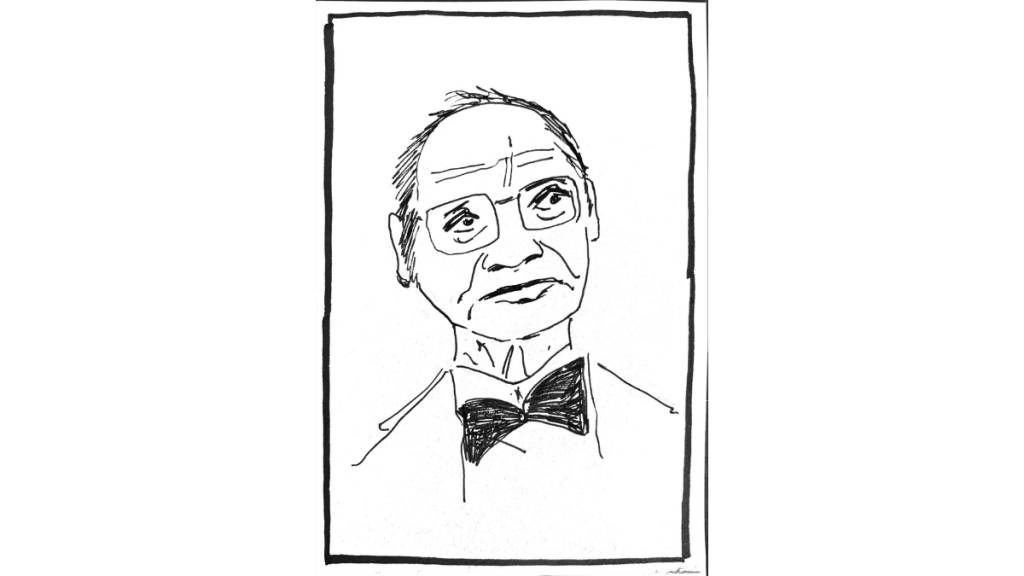
What Macaulay ideated through his words, Nirad Chauduri consummated through his being — ‘a class of persons Indian in blood and colour but English in opinions, in morals and in intellect.’ Indubitably, in every sense of the word, he was an anglophilic polymath who could spurt Latin phrases, French words, even make allusions to the esotericisms of classical music, redeeming even the moderately-erudite Englishman into a green-eyed monster.
Linguistic profundities aside, Chaudhuri’s writing methodology is something laudable. By virtue—or sin (thoughts which presumably could’ve surfaced in the mind of our protagonist) — of being born an Indian, his language did not — or so he felt — come off as natural; and so he would test his (rather ornate) sentences against the ones written by English writers, by reading them aloud successively. This eclectic class ranged from Joseph Hooker to George Moore. If it sounded home-grown enough, he would go big guns (at the least expectedly so, for all we know). One may be tempted to label this as a purist tendency, yet his tenacious efforts and attainments speak of his penchant for the Master’s language, which, through a latitudinarian lens, is commendable indeed.
What most provoked the ire of fellow Indians was his blind adulation of the British civilisation. To quote one, the dedication he unabashedly attributed to the British in his The Autobiography of an Unknown Indian reads: ‘To the memory of the British Empire in India, which conferred subjecthood on us but withheld citizenship; to which yet every one of us threw out the challenge: “Civis Britannicus Sum” because all that was good and living within us was made, shaped and quickened by the same British rule.” That he endorsed the British niceties was an established fact then, but this one went overboard for it evinced an oblique flattery of the master at the cost of coating them in rose-tinted, mellowed criticisms. In a latter essay of his entitled Apologia Pro Scripta Sua, he makes the claim that it was nothing but a condemnation of the British, likening it to what Cicero said of the oppressor Vewes and his sore declaration “Civis Romanus Sum.” But even so, his defence remains hollow, strait-laced, and unconvincing at best.
Though English in intellect, the Bengali Nirad-Babu makes for an interesting character, for the study of the sociology of Indian-English writers. From being a journalist to a ‘vocational’ writer, and to an unsound preacher, the man’s unfavourable voice was imbued with slight quavers, which fought hard to wade through the cacophony of liberal Indian tones. One may or may not accede to his semantic adventures, but his style remains a deviant invention, praiseworthy or not.
 The Unsaturated Reader
Leave a comment