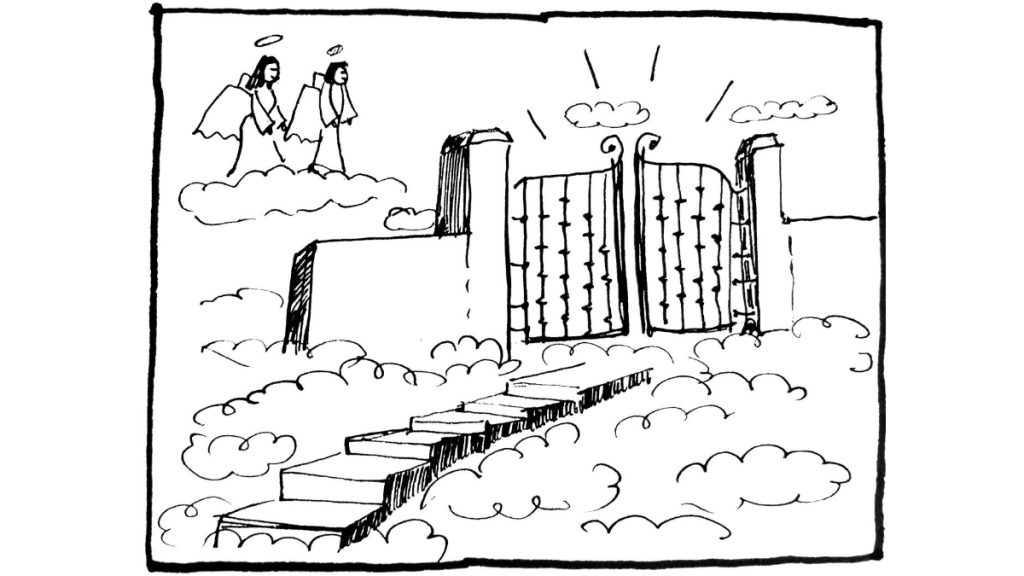
Paradise. That symphonic destination humans have hankered for centuries. It makes them philanthropes. It makes them holier-than-thou.
It makes them sympathize the penurious, save the callous dough thrust at their warped ashet, inedible perhaps.
It makes them plonk that extra penny into the crevice of the gold-rimmed temple coffer; which sits before the deity, destined for the priest, brimming of course.
It turns them into devout sycophants.
As for the obtuse casuists, some remain in their nutshells while some, in the garb of religion, become extremists.
To descend on Swarg Loka, tarry in its bountiful pleasures until next birth or; to reach the garden of Jannah, the “gardens of pleasure”—the prospects of which deliquesces many to the realms of piety— appears to be the ultimate pursuit of almost all, barring the atheists. This heavenly pursuit makes the world a better place alleges the blind optimist : “It turns them into Good Samaritans!”
As the frothy waves gush through the meanders, so does it bring along the dross, the debris, the incongruous rocks; just like the offcuts of many good deeds in this world. No endeavor is ever so pristine in its motives. In the course of one’s journey towards the end, top or bottom, the naives are sometimes impelled from within to despise what doesn’t conform to their canons; this robbing them of all virtue that was left, if any.
The rationale behind this dystopian prolixity? It brings me to a 15th century poet who catechized the proponents of these ideas, succinctly razing all that was held banal. Kabir.
It would be an injustice to merely regard him as a Bhakti poet, just like anybody else who would have traversed similar terrains during those times. For poetry aside, he is deserving of titles like philosopher ,social commentator and satirist. Through his often inconspicuous and riddling rhetoric, adorned with the usage of upside-down language, Kabir exposes the sanctimonious attitudes of ardent religionists and their unfounded beliefs and rituals. A believer of ‘personal god’, he considered himself as ‘the child of Allah and Ram”.
In many of his verses, he disparagingly talks of Hinduism and Islam, their hollow obsessions and esoteric compositions. For instance, he passed snide remarks about Hindus’ and Muslims’ animal sacrificial rituals:
‘One slaughters goats, one slaughters cows, they squander their birth in isms’.
If we are to wade through Kabir’s poems denouncing Hindu and Islamic beliefs in detail, a mere assortment of words would not suffice. That is a topic of contention for another day. If we cloister it to a passage, I’m afraid it would take the form of a panegyric, unintentionally deluding the nuances of it.
Let’s go!
Everyone keeps saying,
As if they knew where paradise is,
But ask them what lies beyond
The street they live on,
They’ll give you a blank look.
If paradise is where they’re heading,
Paradise is not where they’ll end up.
And what if the talk of paradise is just hearsay?
You better check out the place yourself.
As for me, says Kabir, if you’re listening,
Good company’s all I seek.1
The aforementioned is one among Kabir’s works which blatantly reveals his disapproval of the whole purported idea of paradise. It’s also a mockery of society. It underscores their credulity and inability to mull over any idea in depth.
In another set of verses, he deploys the allegory of a ferry that would apparently take him (and his peers perhaps), to their desired destination. In these lines, he inquires, in the guise of a ridicule, ‘Is there a paradise anyway?’
I’m waiting for the ferry,
But where are we going,
And is there a paradise anyway?
Besides,
What will I,
Who see you everywhere,
Do there?
I’m okay where I am, says Kabir.
Spare me the trip.2
Hell and heaven did not qualify as a dichotomy for Kabir as he was indifferent to both. In nâ main dharmî nahîn adharm3 he says,
I am neither pious nor ungodly, I live neither by law nor by
sense,
I am neither a speaker nor hearer, I am neither a servant nor
master, I am neither bond nor free,
I am neither detached nor attached.
I am far from none: I am near to none.
I shall go neither to hell nor to heaven.
I do all works; yet I am apart from all works.
Few comprehend my meaning: he who can comprehend it, he sits
unmoved.
Kabîr seeks neither to establish nor to destroy.
Taking a dig at the unlettered and gullible, in another clever usage of satire, he pillories his dear pandits.
Pandit, do some research
and let me know
how to destroy transiency.
Money, religion, pleasure, salvation—
which way do they stay, brother?
North, South, East or West?
In heaven or the underworld?
If Gopal is everywhere, where is the hell?
Heaven and hell are for the ignorant,
not for those who know Hari.
The fearful thing that everyone fears,
I don’t fear.
I’m not confused about sin and purity,
heaven and hell.
Kabir says, seekers, listen:
Wherever you are
is the entry point.
These lines are suffused with his intrepidity and clarity of thought. He is seldom ambiguous. He speaks his mind, and that too, to those worthy of such admonishments.
Lastly,
‘O Qazi, nothing is accomplished by mere talk
By fasting, passing the time with prayers and the creed will not achieve paradise;
He who knows how can view the Ka’ba in his own body’
As is evident, Kabir is jeering at the Qazi4, scoffing at his rendition of prayers five times a day and the month-long fasts he undertakes every year.
Eulogies aside, one has to be cautious while credulously taking Kabir’s words as gospel since much of what we deem to have hailed from Kabir may not be his after all. Owing to the unavailability of authentic manuscripts that dates back to his period, credibility of the lines attributed to him remains elusive. Nevertheless, his verses were passed onto each generation orally and scholars devoted to his works have extracted these and compiled them with astonishing dexterity.
Today, some of Kabir’s verses remain inscribed on tattered pages of textbooks, soon to be erased from the minds of indolent highschoolers, thanks to the conundrum of impotent ideas she’s fed thereafter. Perhaps, considering the erratic times we live in, we need to hark back to these verses once in a while. One, so as to take refuge from the cloister of insanity we’ve been trapped in and two, more importantly, to forbid our gullible natures from being preyed on by the corrupt.
Moreover, injustice and intolerance pervading our times have forced us to rethink and scrutinize our own actions; actions to please somebody, some unknown.
For all we know, as Kabir put it,
‘What if the talk of paradise is just hearsay?’ And, ‘Is there a paradise anyway?’
Notes
[1] K., Mehrotra, A. K., & Doniger, W. (2011). Songs of Kabir. Adfo Books.
[2] Ibid.
[3] Retrieved from SONGS OF KABÎR – Translated by Rabindranath Tagore
Full text available here.
[4] Qazi is a Muslim judge who delivers decisions in accordance with the Shariah Law.
More
A notable work worth mentioning :
The Bijak of Kabir by Linda Hess
 The Unsaturated Reader
Leave a comment