
‘The Visible Muslim, Invisible Citizen’ is a book that proposes to understand the various tenets of Islam in the Indian Democracy. In his book, Khurshid attempts to analyse and provide a discourse on the question that is pertinent to every Indian Muslim, “What am I as a muslim?”
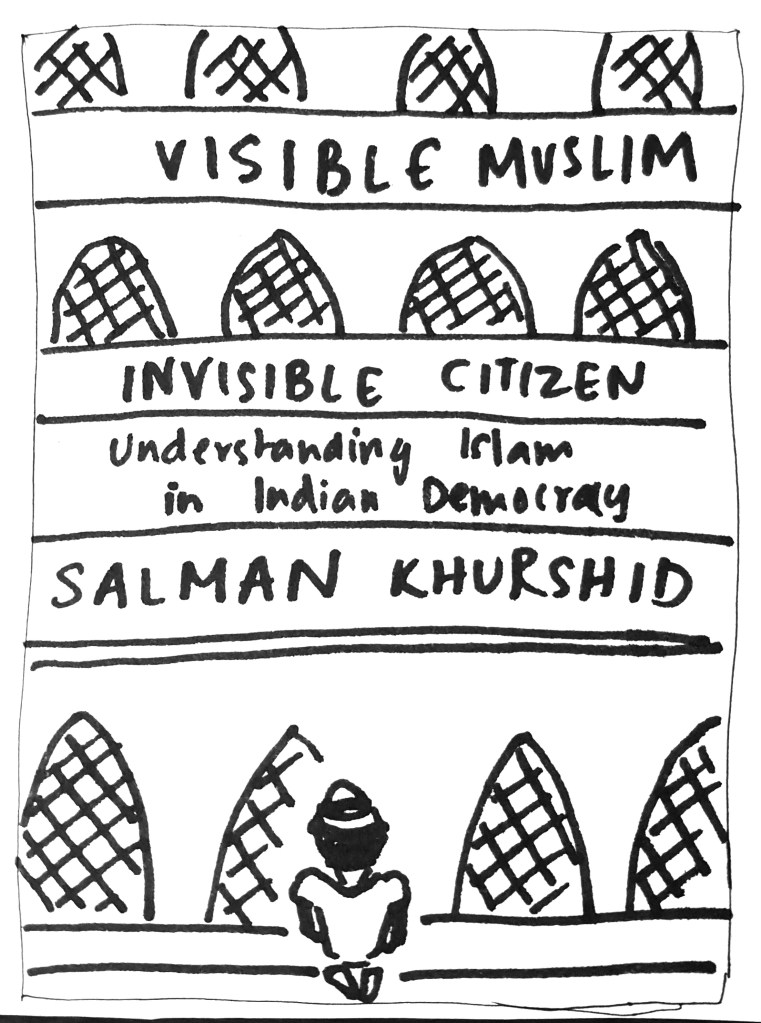
With the book centring on a span of topics that would be of interest to the inquisitive mind like ‘Aligarh Character Assassination’ to ‘Sufi Traditions’ , one only wishes that the author had written more on it rather than confining them briefly to a few pages. The author, professing his excellency in writing, leaves readers like myself for instance, yearning for more after each chapter.
The book begins with the description of India as a collection of multiple nationalities, the important roles that Muslims played throughout India’s struggle for independence, its history and hence proceeding onto the sensitive topic of partition. In one of the later chapters, the author notes with utmost optimism that if the reunification of Vietnam, Germany, end of apartheid in South Africa et al, had been possible, then the prospect of India and Pakistan dwelling in peace is not only achievable but also imperative for humankind. As for the involvement of Indian Muslims in the freedom struggle, Khurshid quotes the prominent writer Khushwant Singh saying, “Indian freedom is written on Muslims’ blood, their participation in [the] freedom struggle was much more in proportion to their small percentage of population.” This is indeed true, as the book chronicles the vast achievements of Indian Muslims, their persistent effort in diminishing the imperial rule and denouncing the jeopardising framework laid down my the colonials. A stirring account of the emergence of the Aligarh Muslim University (AMU) in the chapter ‘Aligarh Character Assassination’ gives one all right to believe in the extraordinary achievements of Muslims in the field of education and Sir Syed Ahmed Khan’s desire of setting up an ‘Oxbridge in the East,’ from whom the very idea of AMU was born. Further moving on, the book gives an understanding of the much debated Enemy Property Act, its implications with authentic statistics and and also, as uncanny as it may sound, a vague and condensed view on the curious case of ‘Love-Jihad’. A reader would certainly find the portion lacking in precision as the author tends to make an ambiguous judgement with regard to the issue.
In one of the later chapters, the author notes with utmost optimism that if the reunification of Vietnam, Germany, end of apartheid in South Africa et al, had been possible, then the prospect of India and Pakistan dwelling in peace is not only achievable but also imperative for humankind.
Khurshid also attempts to give an elaborate view on the contentious ‘Triple Talaq’ alluding to its ‘inherent odious nature’ and ‘questionable pedigree’. The current hotly debated case of ‘Babri Masjid’ finds its way into the book with the author producing an excellent account of its compelling history, which every Indian must know, and the different claims that has been laid down by various groups over the years regarding the actual proprietor of the land. Since Babur, the founder of the Mughal Dynasty, has been the prime target of many these days, for having invaded India and ruled, the author says, ‘The fact is quite the opposite, if we recall the poignant way in which Babur gave up his life for Humayun and his relationship with India, even if he did hope to return to his native land Kabul and be buried there’. A wealth of other riveting narratives appears in this book such as the history of Islam, Sufi traditions, matters of belief and faith and the lamented discontinuance of the Sachar Committee, a committee institutionalised for the report sought by the 2005 Dr. Manmohan Singh government on the contemporary status of Muslims in India.
However, despite the ignorable inadequacies of the book, one would not disagree that the author’s brilliant take on the authoritativeness of Fatwas and Muftis is the icing on the cake.
Although the apposite titling of the book intrigues one to devour in it, it must be noted that the book only partly does justice to the title as the book remains unclear with its objectives in parts that require a preconceived consensus. Nevertheless, it must be treated as a great read as it is one-of-a-kind books out there that seeks to be explanative of the plethora of issues that affect Indian muslims today and the lesser-known facets of their fascinating history. Their achievements, efforts, hard work had blossomed into our knowledge quite infrequently and this book would definitely make its way into rectifying those.
 The Unsaturated Reader
Leave a comment